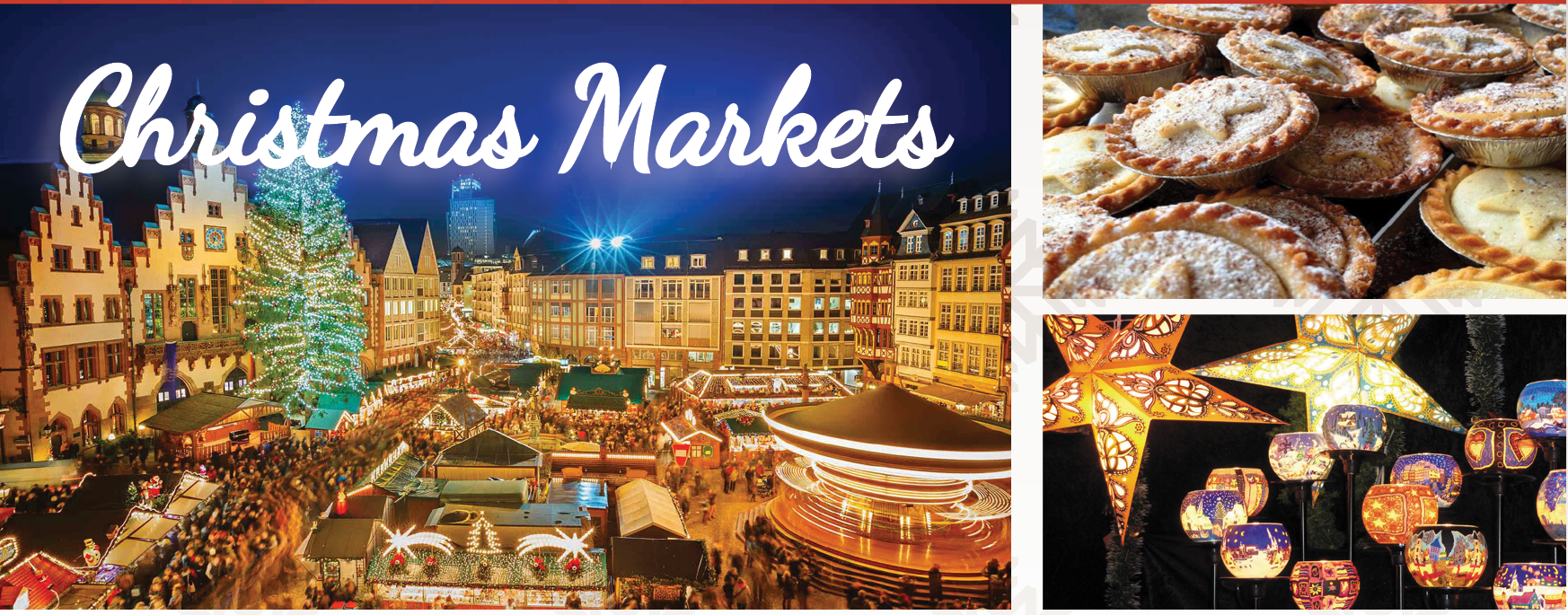
Christmas Markets
Germany or Italy? Strasbourg or Norway? The festive season might feel a long way off, but the season of Christmas markets will be here before you know it. Large or small, each market reflects the culture of the region – food, drink, music and more.
INNSBRUCK November 15 2016 – January 6 2017
Of the half-a-dozen markets in Innsbruck, the most romantic is in the Altstadt, lined with medieval houses. Stalls are piled high with gingerbread, wooden toys and delicate ornaments made of handblown glass. At dusk, trumpeters play carols on the 500-year-old Golden Roof. Try the kiachln – Advent doughnuts – served hot, with cranberry sauce. At weekends, ride the funicular up Nordkette mountain to Hungerburg. After tasty treats at this little market, continue your journey to the top of the Hafelekar for views of twinkling city lights and snow-tipped peaks.
GERMANY – HAMBURG November 21 – December 23 2016
For sheer diversity, Hamburg is hard to beat. In this historic port, 15 different markets cater to all tastes. Traditionalists head for the square in front of the grandiose city hall, where the rows of stalls are themed, from sweet treats (cakes, chocolates and more) to crafts (leather, silver, tree ornaments). Children are entranced by the Spielzeuggasse, the Toy Street, which is full of playthings from around the world. Romantics opt for the Jungfernstieg market, whose focus is on posh food and gifts; while crowd-avoiders choose the smaller Fleetinsel market by the water, where fairy lights twinkle on antique sailing boats. Strictly for over-18s is the risqué Santa Pauli market on the X-rated Reeperbahn.
STRASBOURG November 25 – December 31 2016
Year round, Strasbourg scores for traditional charm, but during Advent the capital of Alsace is even more magical. Half-timbered houses sport giant red-and-white hearts; stars, angels and snowflakes garland the cobbled streets. Here, the Christkindelsmärik dates back to 1570 and even the towering fir tree on the Place Kléber is a 400-year-old custom. Check out the 11 different “villages” – themed areas – and don’t miss the bredele biscuits, a local speciality. These special biscuits come in all shapes and flavours, from hazelnut, orange and cinnamon to walnut, coconut and praline. Take them home. Hang them on your tree… Then eat them.
STUTTGART 2016 dates TBC
Dating back to 1692, the Stuttgarter Weihnachtsmarkt is one of Germany’s best-known pre-Christmas jamborees. In the car-free, old heart of this compact city, the air is scented with spiced wine and boughs of fresh pine. From the Schlossplatz to the Marktplatz, some 300 stalls snake along the cobbled streets; decked out with bright ornaments and sparkling lights, they compete for the coveted title of “best decorated”.
COLOGNE November 21 – December 23 2016
Cologne has not one but seven Christmas markets. Head to the Old Town’s cobbled Alter Markt and Cathedral markets for candles, tree decorations and handmade lacework. The fairy-tale St Nick’s Village on Rudolfplatz is good for wooden toys, and locals’ favourite Neumarkt’s Angel’s Market for Dresden Stollen cake. Among the trees of the Stadtgarten is a more leftfield market selling Mongolian slippers, jewellery and dozens o f different honeys. It’s a peaceful spot to sit with a mug of glühwein.
ITALY – BOLOGNA November 20 2016 – January 6 2017
Forget “Merry Christmas” – in Bologna, “Buon Natale” is the greeting you hear in the seasonal markets. Spreading alongside the 12th-century San Pietro Cathedral is the Fiera di Natale, while the smaller Antica Fiera di Santa Lucia centres on the cloister of the Santa Maria dei Servi church. Bologna is synonymous with good food. Mouthwatering creations are everywhere, from marzipan fruits and citrus peel dipped in dark chocolate, to torrone – a festive-season nougat made with nuts and honey.
SWEDEN – STOCKHOLM November 23 – December 23 2016
Although the first Christmas market on Stortorget square in Old Stockholm was held 500 years ago, the modern event dates back “only” a century. In front of the Nobel Museum, close to the Royal Palace, the cheerful stalls are filled with crafts made only in Sweden, such as glass, pottery and jewellery. Prices are surprisingly affordable. Grown-ups sip glögg (mulled wine) and everyone munches pepparkakor – thin ginger biscuits. With a dusting of snow, it all looks like a Christmas card, Scandinavian-style. Be sure to bring home a taste of Sweden: saffransbullar (saffron buns) and vacuum-packed sausages made of – don’t tell the children
NORWAY – TRONDHEIM 2016 dates TBC
Should you find yourself in this Arctic city make a beeline for Torvet, the main square, where you’ll find clusters of wooden chalets and traditional Sami lavvos (tepee-style tents). Burning braziers and horse-and-sleigh rides add to the charm. Buy hand-woven scarves and ceramic wine goblets, berry-flavoured cheeses and dried reindeer meat. Refuel with moose burgers, waffles with blueberries, and tankards of mulled wine around open fires in the lavvos. Don’t miss a walk across Gamle Bybro (Old Town Bridge) to the brightly-painted timber houses of Bakklandet, the city’s former working-class district.
SWITZERLAND – ST GALLEN November 24 – December 24 2016
Only an hour from Zurich, St Gallen ticks all the festive boxes: a Baroque cathedral, wonderfully ornate Medieval buildings, and picture-postcard views of snow-covered mountains. Kicking off the Advent fun is the lighting of Switzerland’s tallest Christmas tree, accompanied by carol singing. Look out for biberli. Typical of St Gallen, these ginger bread/marzipan concoctions come in different shapes, have different decorations, and are always delicious. To warm up, drop by a Beizli, little pub, for a mug of feuerzangenbowle – a wine and rum fire punch. CZECH REPUBLIC – PRAGUE December 3 2016 – January 4 2017 Prague’s Old Town Square, Staromestske namesti, has a stage-set nativity scene, a huge tree and daily performances by folk bands and choirs. Comb the stalls – both here and in neighbouring Wenceslas Square – for carved wooden toys, Bohemian crystal, garnet jewellery and traditional straw and maize decorations. Eat klobasa (Polish sausage) or trdelnik, a hot, sugarcoated pastry. Catch an evening concert in one of the city’s churches, such as St Salvator, St Clement’s Cathedral or St George’s Basilica. BELGIUM – BRUGES November 18 2016 – January 1 2017 The main stalls in Bruges are found in Market Square, overlooked by the 13th-century Belfort (belfry), and in Simon Stevinplein. There are plenty of places to buy handmade jewellery, wooden toys, hats and scarves, leather goods and, of course, chocolates. Don’t miss the local beer at Staminee de Garre, a cosy